




09 June 2026
Climate Volatility Is Reshaping Agriculture Faster Than Many Systems Can Adapt
For decades, agriculture has operated around one fundamental assumption:
The environment would remain relatively predictable.
Farmers could estimate rainfall patterns, planting seasons, pest cycles, and harvest windows with reasonable confidence.
Today, that assumption is rapidly disappearing.
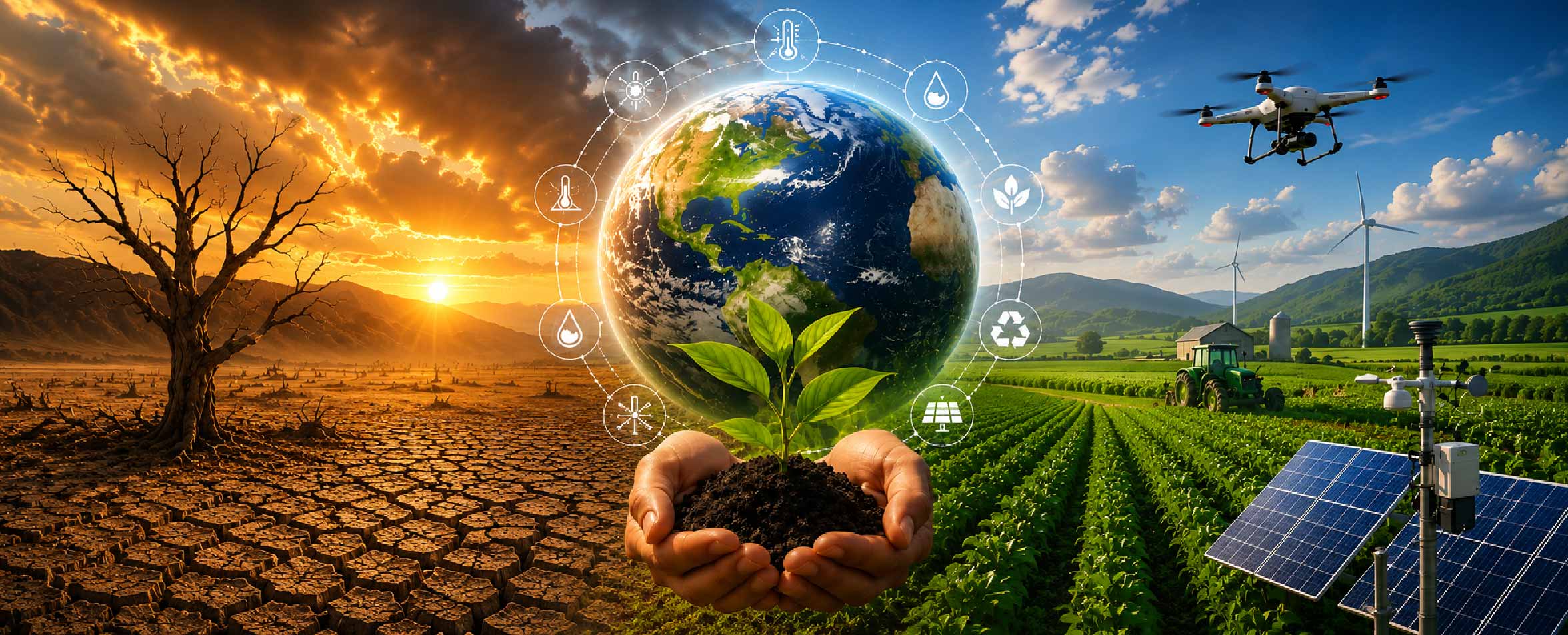
Across the world, climate volatility is introducing new levels of uncertainty into agricultural systems. Droughts are becoming more frequent in some regions, while floods and extreme rainfall events are increasing in others. Heatwaves, changing growing seasons, water scarcity, and unpredictable weather patterns are affecting how food is produced, distributed, and consumed.
The challenge is no longer whether climate change will affect agriculture.
The challenge is how quickly food systems can adapt.
Climate Volatility Is Different From Climate Change
Climate change refers to long-term shifts in global weather patterns.
Climate volatility refers to the increasing unpredictability and variability of those patterns.
For agriculture, volatility often creates more immediate challenges than gradual changes in average temperatures.
A farmer may be able to adapt to slightly warmer conditions over time.
It is far more difficult to adapt when rainfall arrives weeks later than expected, when temperatures fluctuate dramatically during critical crop stages, or when extreme weather events occur with increasing frequency.
This growing unpredictability is becoming one of the most significant risks facing global food production.
Agriculture Remains Highly Dependent on Natural Systems
Despite advancements in technology, agriculture remains deeply connected to environmental conditions.
Crop yields are influenced by:
- Temperature
- Rainfall patterns
- Soil moisture
- Water availability
- Pollinator activity
- Ecosystem health
When these systems become unstable, agricultural productivity becomes more vulnerable.
In many regions, farmers are already experiencing shorter planting windows, shifting growing seasons, and increased pressure from pests and diseases that thrive under changing environmental conditions.
The result is greater uncertainty across food production systems.
Water Security Is Emerging as a Defining Challenge
Water has always been central to agriculture.
Climate volatility is making water management increasingly difficult.
Some regions face prolonged droughts and declining groundwater reserves.
Others experience intense rainfall events that lead to runoff, soil erosion, and reduced water retention.
This creates a paradox where both water scarcity and water excess can threaten agricultural productivity.
Future food systems will increasingly depend on:
- Efficient irrigation systems
- Water conservation technologies
- Precision agriculture
- Soil health management
- Climate-smart farming practices
The ability to manage water effectively may become one of the most important determinants of agricultural resilience.
Food Security Is Becoming More Complex
Climate volatility affects more than crop yields.
It influences the entire food system.
Production disruptions can impact:
- Food availability
- Food affordability
- Supply chain stability
- Rural livelihoods
- Market confidence
A single extreme weather event can create ripple effects throughout agricultural value chains.
These interconnected impacts highlight why food security can no longer be viewed solely through the lens of production volumes.
Resilience, adaptability, and system stability are becoming equally important.
Climate Resilience Is Becoming a Strategic Priority
Historically, agricultural success was often measured through productivity alone.
Today, resilience is becoming just as important.
Climate resilience refers to the ability of agricultural systems to anticipate, withstand, adapt to, and recover from environmental disruptions. This includes:
- Climate-resilient crop varieties
- Regenerative agriculture practices
- Diversified farming systems
- Improved soil management
- Early warning systems
- Data-driven decision making
The goal is not simply to maintain production.
The goal is to create systems capable of functioning effectively under uncertainty.
Technology Is Accelerating Agricultural Adaptation
The future of climate resilience is increasingly tied to technology.
Artificial intelligence, predictive analytics, satellite monitoring, and digital agriculture platforms are helping farmers and researchers make more informed decisions.
These technologies can support:
- Weather forecasting
- Pest and disease prediction
- Irrigation optimization
- Resource management
- Yield forecasting
Rather than reacting to challenges after they occur, producers can increasingly anticipate risks before they become severe.
As climate volatility increases, predictive intelligence may become one of agriculture’s most valuable assets.
Sustainable Agriculture Is Part of the Solution
Climate adaptation and sustainability are often discussed separately.
In reality, they are deeply connected.
Healthy soils store more water.
Biodiverse ecosystems improve resilience.
Efficient resource management reduces environmental pressure.
Sustainable agricultural practices help create systems that are better equipped to withstand climate-related disruptions.
This is why many researchers now view sustainability not only as an environmental objective but also as a resilience strategy.
Why Collaboration Will Matter More Than Ever
No single organization, institution, or country can address climate-related agricultural challenges alone.
Future resilience will require collaboration among:
- Researchers
- Policymakers
- Farmers
- Agribusiness leaders
- Technology innovators
- Investors
- Sustainability experts
Knowledge sharing and cross-sector partnerships will play an increasingly important role in developing scalable solutions.
The future of agriculture depends on collective action as much as technological innovation.
The Future Belongs to Adaptive Food Systems
Climate volatility is not a temporary disruption.
It is becoming a defining characteristic of modern agriculture.
The most successful agricultural systems of the future may not necessarily be those that produce the most.
They may be the systems that adapt the fastest.
Building resilience requires a shift in perspective.
Instead of focusing solely on productivity, future food systems must prioritize adaptability, sustainability, intelligence, and long-term stability.
The question is no longer whether agriculture will change.
The question is how effectively food systems can evolve to meet a more uncertain future.
Looking Ahead
Agriculture stands at a critical moment.
Climate volatility is reshaping the conditions under which food is produced, distributed, and consumed.
While the challenges are significant, they are also creating opportunities for innovation, collaboration, and transformation.
The future of agriculture will increasingly depend on resilient systems, climate-smart technologies, and integrated approaches that balance productivity with sustainability.
Those who invest in resilience today may be better positioned to thrive in the food systems of tomorrow.
Frequently Asked Questions
Climate volatility refers to increasing unpredictability in weather patterns, including extreme temperatures, irregular rainfall, droughts, floods, and other environmental disruptions that affect agricultural systems.
Climate volatility can reduce crop yields, disrupt supply chains, increase food prices, and create uncertainty in food availability, impacting overall food security.
Climate resilience helps agricultural systems anticipate, adapt to, and recover from environmental challenges while maintaining productivity and sustainability.
Climate-smart practices include precision farming, regenerative agriculture, efficient irrigation, improved soil management, and climate-resilient crop varieties.
Technologies such as AI, satellite monitoring, predictive analytics, and digital agriculture platforms help improve decision-making and risk management.
Effective water management improves agricultural productivity, conserves resources, and helps farms adapt to changing environmental conditions.
Yes. Sustainable agriculture improves soil health, biodiversity, resource efficiency, and ecosystem resilience, making food systems more adaptable to climate challenges.
SHARE :